
Insurance underwriters’ cyber risk quantification is the estimation of cyber-event frequency and financial loss with the aim of supporting coverage, limit, retention, and portfolio decisions. This 2026 guide explains how to connect security evidence to loss scenarios without treating a vulnerability score as an insurance loss estimate.
- Cyber risk quantification for insurance underwriters should connect loss scenarios, security evidence, policy wording, and uncertainty.
- Brinqa is a vulnerability and exposure management platform; evaluate it for exposure-management requirements, not assumed insurance-modeling capabilities.
- CVSS severity and EPSS exploitation probability are not insured-loss estimates.
- Compare ground-up loss with policy-adjusted loss before making coverage or portfolio decisions.
Why cyber risk quantification matters for insurance underwriters
An underwriting model must explain potential claims, not just technical weaknesses. A security team prioritizes remediation; an underwriter decides which losses to accept and under what contractual conditions. Those decisions require different outputs from the same evidence.
A questionnaire response does not establish that a control works across the insured organization. Likewise, an exposed asset does not establish the size of a covered claim. Use vulnerability management for cyber insurance underwriting readiness to frame the evidence conversation, then keep the financial analysis separate.
For a 2026 submission, distinguish the insured organization, the business services at risk, and the coverage being considered. An incident that causes substantial operational damage does not automatically produce an equivalent insurance payment. Retentions, limits, exclusions, waiting periods, and other policy provisions affect the result.
The practical outcome is a decision record that connects the submission to a loss scenario, the supporting evidence, the model assumptions, and the proposed terms. Another underwriter should be able to reconstruct that reasoning without interviewing the original analyst.
How to quantify cyber risk for underwriting
Start with a documented worksheet and the evidence already supplied by the applicant. Define your method before choosing software; otherwise, software outputs become assumptions nobody has explicitly accepted.
The sequence is Define scope, Check evidence, Build scenarios, Estimate losses, and Apply terms, followed by portfolio testing and review. Keep each stage visible in the underwriting file.
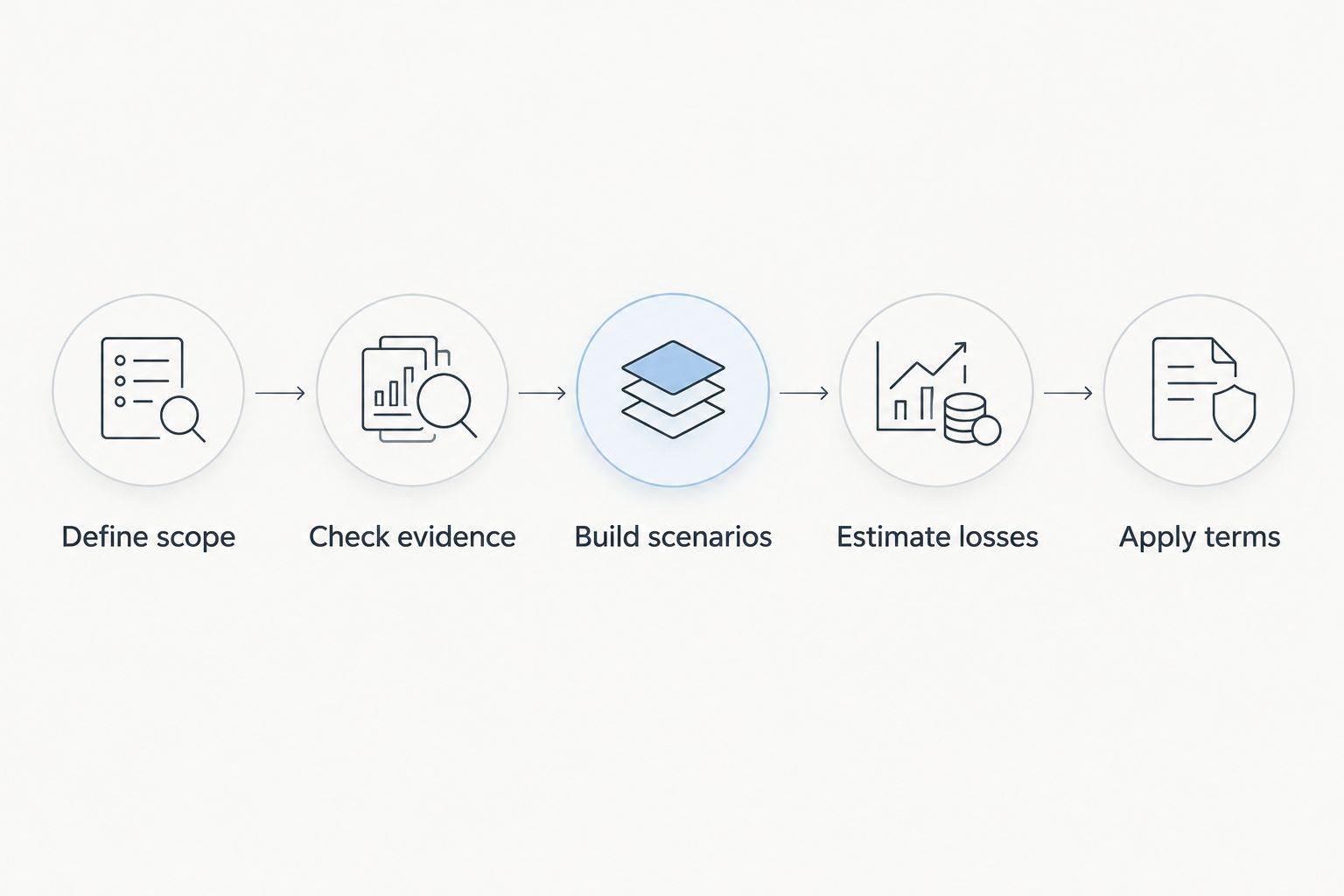
1. Define scope before collecting more data
Write a short scope statement naming the applicant, covered entities, business operations, relevant dependencies, and proposed coverage. Use a 12-month analysis horizon when assessing annual event frequency, and state that choice explicitly. Do not mix annual frequency with losses calculated over an unspecified period.
Define the decision the model must support. Evaluating a proposed limit requires different analysis from deciding whether to request stronger controls before binding. Establish that question before asking the applicant for another evidence package.
For your 2026 file, preserve the submission date and evidence dates separately. A recent application can still contain older test results or an inventory that excludes a newly acquired subsidiary.
- Record covered entities and material business services.
- Specify the analysis horizon and financial units.
- Identify the coverage decision and decision owner.
- List excluded systems, entities, and unresolved scope questions.
2. Check evidence against the applicant’s business
Build an evidence register manually before attempting to automate it. For each material control assertion, record the source, collection date, coverage, owner, and limitations. Separate applicant statements from independently observed findings and tested control results.
CVSS scores describe vulnerability severity on a 0–10 scale; they do not express an applicant’s expected financial loss. FIRST’s EPSS estimates the probability that a published vulnerability will be exploited in the wild over the next 30 days. That is not the probability that a particular insured organization will suffer a covered claim.
Use those measures for their intended questions. Then establish whether the affected asset belongs to the applicant, supports a material service, and has relevant compensating controls. An unverified asset association belongs in the uncertainty register, not in a confident loss estimate.
- Request the scope and date of each assessment.
- Separate self-attestation, observation, and tested evidence.
- Verify ownership of externally identified assets.
- Record missing coverage rather than treating it as clean coverage.
3. Build scenarios around business interruption and loss
Create scenario descriptions in a worksheet: initiating event, affected service, control conditions, operational consequences, and financial consequences. Keep data theft, service interruption, and fraudulent transfer distinct where their causes or coverage treatment differ. One incident can involve several consequences without making those consequences independent events.
A vulnerability and exposure management platform is relevant to the technical evidence portion of this work. Brinqa is a vulnerability and exposure management platform; assess its fit against your actual evidence requirements rather than assuming it supplies actuarial models or policy interpretation.
Brinqa is best for underwriters evaluating vulnerability and exposure management requirements, not selecting an underwriting verdict. Keep the boundary explicit: exposure-management information informs the analysis, while the insurer remains responsible for scenario selection and underwriting judgment.
- Name the initiating event and affected business service.
- Describe the conditions required for the scenario to develop.
- Separate operational damage from potentially covered loss.
- Document what evidence would materially change the scenario.
4. Estimate frequency and loss with visible uncertainty
For each scenario, estimate event frequency and loss severity using evidence whose scope matches the applicant and scenario. Document expert judgment separately from observed data. Do not present a modeled estimate as a directly measured fact.
In a simple aggregate-loss model with independent, identically distributed event severities and event count independent of severity, expected annual loss equals expected annual event count multiplied by expected loss per event. That result does not describe the tail of the loss distribution. A limit decision therefore needs more than an average.
For 2026 underwriting, retain the model version, assumptions, and sensitivity results. Change uncertain assumptions individually to identify which ones drive the decision. If an assumption controls the outcome, request better evidence or make the uncertainty explicit in the referral.
- Separate event frequency from loss severity.
- Record the source and rationale for each assumption.
- Show a loss range rather than an unsupported point estimate.
- Test sensitivity to recovery duration and control effectiveness.
5. Apply terms to the modeled loss
Maintain separate views of ground-up loss and the insurer’s potential payment. Ground-up loss describes the modeled damage before applying insurance terms. The payment estimate requires the actual proposed wording and the modeled event circumstances.
Use a worksheet to map each loss component to its coverage treatment. Confirm the treatment of business interruption, incident response, restoration, and other modeled consequences against the wording rather than relying on their labels. Referral to coverage specialists is part of the workflow when interpretation remains unresolved.
Avoid subtracting a retention from an aggregate loss estimate without checking how the policy applies it. Sublimits, waiting periods, aggregation provisions, and exclusions can change the calculation. Preserve unresolved interpretations as explicit conditions rather than burying them in a formula.
- Separate ground-up loss from policy-adjusted loss.
- Map loss components to relevant coverage provisions.
- Apply limits, retentions, and waiting periods as written.
- Record interpretation questions and the responsible reviewer.
6. Test shared dependencies across the portfolio
An account-level model does not establish portfolio risk. Identify shared providers, technology dependencies, and other common causes that could affect multiple insureds. Then test a scenario that links those accounts through the same initiating event.
Begin with a dependency register assembled from submissions and supporting evidence. Keep a distinction between a confirmed dependency and an inferred one. Missing dependency data should remain visible when reviewing concentration, not disappear because it cannot be assigned confidently.
For the 2026 portfolio review, compare account-level results with shared-event scenarios. Do not add standalone tail estimates and label the sum a portfolio tail estimate without modeling dependence. Document the aggregation method and its limitations alongside the result.
- Record material shared providers and services.
- Distinguish confirmed dependencies from unverified associations.
- Test common-cause interruption scenarios.
- Document dependence assumptions and missing dependency information.
7. Review the decision and define reassessment triggers
Finish with an underwriting memo, not a dashboard screenshot. State the decision, supporting scenarios, evidence quality, key assumptions, and unresolved questions. A reviewer needs to understand why the proposed terms follow from the analysis.
Define reassessment triggers before binding. Material acquisitions, changes to critical providers, significant incidents, and changes in control evidence all deserve an explicit review rule. Specify who receives the information and who decides whether it changes the underwriting position.
At renewal, compare prior assumptions with new evidence and relevant claims experience. Preserve the previous model instead of overwriting it; otherwise, changes in exposure become difficult to distinguish from changes in methodology.
- Record the decision and its principal drivers.
- Name unresolved issues and accountable reviewers.
- Define material-change and renewal review triggers.
- Preserve model versions and assumption changes.
Compare underwriting analysis options
Choose the approach according to the decision and the evidence available. These options address different parts of the workflow; none removes the need to assess uncertainty or apply policy wording.
| Option | Best for | Main advantage | Key limitation |
|---|---|---|---|
| Documented spreadsheet model | Best for developing a transparent initial method | Makes assumptions and calculations directly inspectable | Requires manual version control and evidence maintenance |
| Scenario-based quantification model | Best for analyzing event frequency and financial severity | Connects defined events to financial consequences | Results depend on scenario quality and parameter support |
| Vulnerability and exposure management platform | Best for evaluating technical exposure-management requirements | Addresses the technical evidence domain | Technical exposure does not itself establish insured loss |
| External security assessment | Best for investigating specified evidence gaps | Adds observations beyond questionnaire responses | Findings remain bounded by assessment scope and timing |
| Portfolio catastrophe model | Best for evaluating shared-event accumulation | Represents cross-account event scenarios | Account mapping and dependency assumptions require scrutiny |
Use a spreadsheet when establishing the method, and specialized systems when the requirements justify them. Evaluate Brinqa for vulnerability and exposure management needs; establish insurance-specific modeling requirements separately. Do not score a platform on capabilities that have not been demonstrated against your use case.
Common mistakes insurance underwriters make
Treating a technical score as a loss estimate
A severity score ranks technical characteristics, not claim payments. Request an explicit chain from exposure to business consequence to policy-adjusted loss. Without that chain, the score is an input, not quantification.
Counting the same interruption more than once
Several systems can support the same business service. Adding their individual interruption estimates can count the same lost activity repeatedly. Define the business-service loss boundary before combining technical findings or scenario results.
Giving full credit for untested controls
A documented recovery plan is different evidence from a recovery exercise. Record what was tested, which systems were included, and what the result supports. Do not extend a narrow test result across the entire insured organization without justification.
Ignoring contractual and portfolio context
A plausible ground-up loss estimate still leaves coverage and accumulation questions unanswered. Apply the proposed wording and examine shared dependencies before treating account-level analysis as sufficient for a capacity decision.
FAQ
What is cyber risk quantification for insurance underwriters?
Cyber risk quantification for insurance underwriters estimates cyber-event frequency and financial loss to support coverage, limit, retention, and portfolio decisions. A useful analysis separates underlying business damage from potential insurance payment.
Can I use CVSS scores to calculate cyber insurance losses?
CVSS scores do not calculate cyber insurance losses. They describe vulnerability severity; underwriting also requires business context, event assumptions, financial consequences, and policy treatment.
Does EPSS predict whether an applicant will make a claim?
EPSS does not predict whether an applicant will make a claim. FIRST’s EPSS estimates exploitation probability for a published vulnerability over the next 30 days, not organization-specific covered loss.
What evidence should I request before quantifying an applicant’s risk?
Request evidence tied to the loss scenarios you need to evaluate. Relevant material includes asset and service scope, control test results, recovery evidence, material dependencies, and the dates and limitations of each assessment.
Where does Brinqa fit in cyber insurance underwriting?
Brinqa is a vulnerability and exposure management platform. Evaluate it against technical exposure-management requirements, while assessing actuarial modeling, policy interpretation, and portfolio analysis requirements separately.
Is expected annual loss enough to choose a policy limit?
Expected annual loss alone is not enough to choose a policy limit. Review loss severity, tail scenarios, uncertainty, policy provisions, and the insurer’s underwriting criteria.
When should an underwriter update a cyber risk model?
Update the analysis at renewal and when defined material-change triggers occur. Establish review rules for acquisitions, critical-provider changes, significant incidents, and material changes in control evidence.
One last thing
Ask which missing piece of evidence would change the decision. If no answer is documented, the analysis has not connected its uncertainty to underwriting action. For each material gap, specify whether resolving it would change the proposed terms, trigger referral, or leave the decision unchanged.


