
A critical vulnerability is a security weakness rated 9.0–10.0 on the Common Vulnerability Scoring System (CVSS) under FIRST’s CVSS v3.1 and v4.0 qualitative scales. That rating describes technical severity, not proof of active exploitation or a universal remediation deadline; your response also depends on exposure, affected assets, and business impact.
- What is a critical vulnerability? FIRST’s CVSS scales classify scores of 9.0–10.0 as critical severity.
- Critical severity and emergency remediation priority are different decisions; validate exposure and exploitation evidence.
- A high-severity vulnerability on an exposed, essential service can outrank an isolated critical finding.
- Brinqa is a vulnerability and exposure management platform; evaluate it against your evidence and response requirements.
What counts as a critical vulnerability?
A vulnerability counts as critical under the FIRST CVSS v3.1 and v4.0 qualitative scales when its score falls between 9.0 and 10.0. The adjacent high-severity band spans 7.0–8.9. Record the scoring version and metric group alongside the number so readers know what the assessment represents.
For your 2026 triage process, keep the published severity separate from your organization’s response priority. The guide to whether CVSS is enough to prioritize vulnerabilities explains that distinction in more detail.
| Classification | CVSS score | Best for | Strength | Limitation |
|---|---|---|---|---|
| Critical severity | 9.0–10.0 | Flagging vulnerabilities in the highest qualitative severity band | Communicates technical severity consistently | Does not establish local exposure or active exploitation |
| High severity | 7.0–8.9 | Identifying serious vulnerabilities below the critical band | Preserves an important technical distinction | Does not mean the finding belongs behind every critical finding |
| Internal response priority | Defined by your policy | Ordering work against your actual environment | Incorporates exploitation, exposure, and business consequences | Requires current evidence and explicit decision rules |
The score is not a percentage. A CVSS score of 9.0 does not mean a 90% probability of exploitation, and a score of 10.0 does not prove an attacker has compromised the system.
Why this matters
Severity tells you how serious a vulnerability is; priority tells you what to address first. Treating those labels as interchangeable creates a queue that ignores where attackers can reach you and what they can disrupt.
Consider an illustrative comparison: a critical finding on a disconnected test asset versus a high-severity finding under active exploitation on an internet-facing production service. The critical label remains valid, but the exposed production service demands an urgent response based on its circumstances.
Your 2026 vulnerability policy should preserve both records. Keep the source severity intact, then document why the organization assigned a particular response priority. That makes the decision explainable without rewriting the underlying technical assessment.
Critical severity: 9.0–10.0 CVSS points
FIRST’s CVSS specifications place 9.0–10.0 CVSS points in the critical band. A critical score reflects the combination of exploitation conditions and consequences encoded in the scoring vector, not a single vulnerability type.
Remote code execution, authentication bypass, and other serious weaknesses require assessment rather than automatic labels. A vulnerability’s name alone does not establish its score. Required privileges, user interaction, attack conditions, and impact all matter.
When a scanner reports a critical finding, capture the CVE identifier when one exists, the affected component, the detected version, and the scoring vector. Also retain the advisory or assessment supporting the result. A red label without supporting evidence is not enough to make a defensible remediation decision.
Recommendation: treat the critical label as a trigger for prompt validation and prioritization, not as a substitute for either.
High severity: 7.0–8.9 CVSS points
FIRST’s CVSS scales classify 7.0–8.9 CVSS points as high severity. These findings sit below critical on the technical scale, but they are not automatically less urgent in your environment.
A high-severity vulnerability deserves escalation when evidence establishes an accessible attack path, relevant exploitation, or serious consequences for an essential service. Conversely, do not reduce a critical vulnerability’s published severity simply because a compensating control currently restricts access.
Maintain separate fields for technical severity and operational priority. Your remediation queue can then reflect local risk without obscuring the original assessment or confusing engineering teams about what changed.
Why critical vulnerability priority varies
The critical threshold is fixed within the cited CVSS qualitative scales. Your response varies because the same technical weakness appears in different environments. Use these factors to explain the difference:
- Exploitation evidence: Distinguish confirmed exploitation from a public proof of concept, a prediction, or an unverified report. These signals support different conclusions.
- Reachability: Establish whether an attacker can reach the vulnerable component through the relevant interface. Internet exposure matters, but internal attack paths matter too.
- Required conditions: Verify privileges, user interaction, configuration, and other prerequisites against the actual deployment rather than assuming they apply.
- Business consequences: Identify the service, data, operational dependency, and accountable owner affected by successful exploitation.
- Verified controls: Check whether segmentation, access restrictions, or a vendor-supported mitigation blocks the relevant attack path. Record the evidence and remaining exposure.
- Remediation constraints: Establish the supported fix, dependencies, testing requirements, and recovery plan. Constraints change the response plan; they do not erase the vulnerability.
For 2026 decision records, avoid descriptions such as low risk without the evidence behind them. State what is reachable, what is affected, and which control has been checked. An exception needs a review condition because systems and attack paths change.
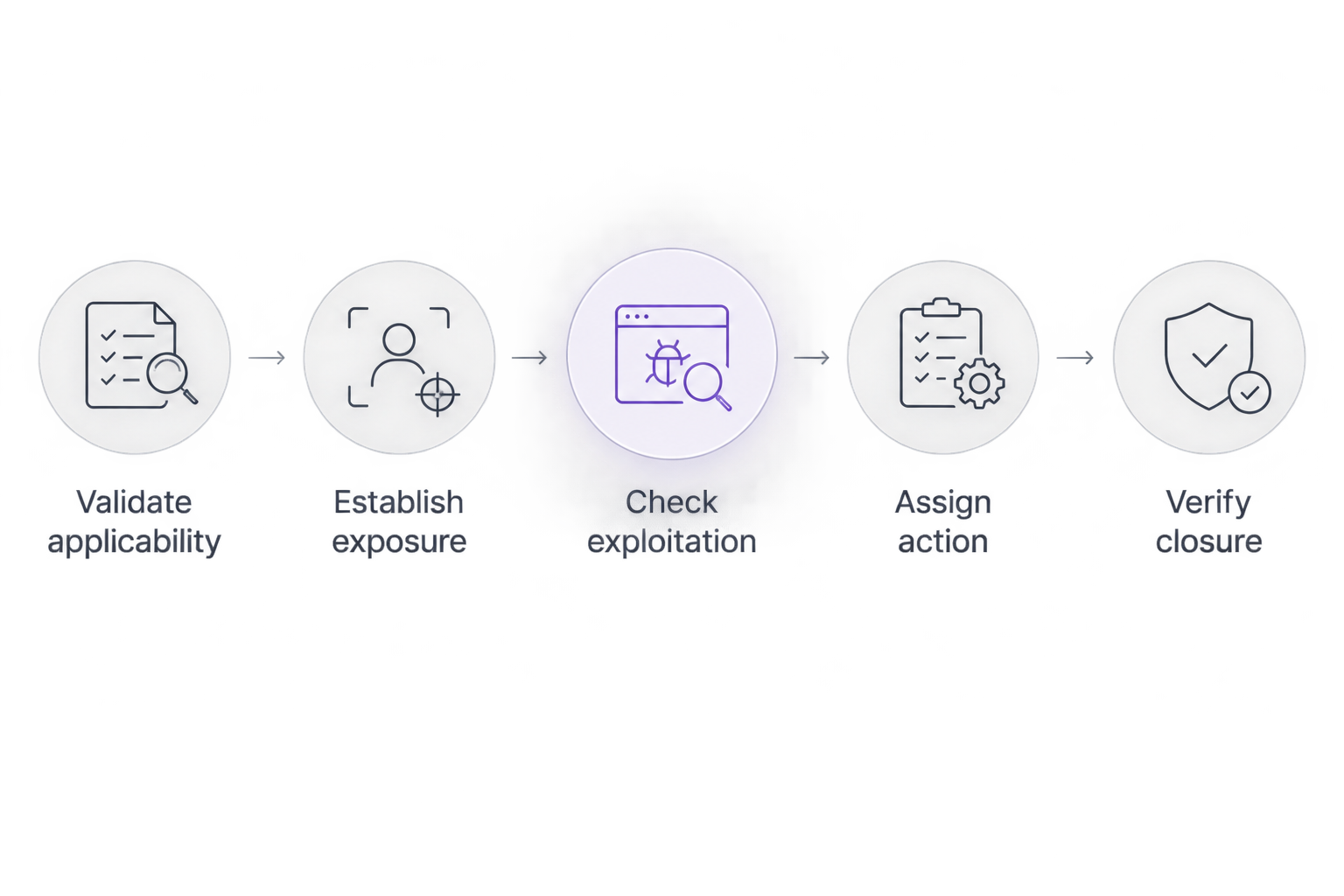
How do you triage a critical vulnerability?
Use a repeatable process that ends with verified risk reduction. Finding an owner or creating a ticket is progress, but neither proves the vulnerability has been addressed.
1. Validate applicability
Confirm that the affected product, version, component, and configuration exist on the asset. Check the scanner evidence against the vendor advisory and available inventory records.
Distinguish confirmed vulnerability, confirmed non-applicability, and unresolved applicability. Missing evidence belongs in the unresolved category, not the safe category. Assign an owner to close that uncertainty.
2. Establish exposure
Determine how an attacker would reach the vulnerable functionality. Review relevant network access, application routes, permissions, and deployment conditions.
Do not assume internal means unreachable. Likewise, a vulnerable dependency in an inventory does not, by itself, prove the application exposes the vulnerable functionality. Record what you verified and what remains unknown.
3. Check exploitation
Review the vendor advisory, CISA’s Known Exploited Vulnerabilities catalog, and relevant threat intelligence. CISA’s catalog identifies vulnerabilities known to have been exploited; it does not certify every unlisted vulnerability as safe.
FIRST’s Exploit Prediction Scoring System, or EPSS, estimates the probability of observing exploitation activity for a published CVE over the next 30 days. That is a different question from CVSS severity and is not a prediction that your particular organization will be breached.
4. Assign action
Name the accountable remediation owner, required action, and target date under your policy. If the fix cannot be applied immediately, evaluate a vendor-supported mitigation or a verified restriction on the attack path.
Record who approved any exception, why the residual risk is accepted, and what triggers reassessment. A ticket that says patch later without those details leaves the decision unfinished.
5. Verify closure
Check the deployed version or configuration and repeat the relevant assessment after remediation. Confirm that the fix reached the affected asset rather than relying only on a successful deployment job.
Where mitigation replaces a permanent fix, retain the distinction. A blocked attack path and a removed vulnerability are different outcomes, and your reporting should say which one you achieved.
What evidence belongs in a critical vulnerability ticket?
A useful critical vulnerability ticket lets the owner act without reconstructing the security assessment. It also lets a reviewer understand why the work received its priority.
Include the affected asset and service, vulnerability identifier, source advisory, observed component version, and evidence supporting applicability. Preserve the CVSS score, version, and vector separately from the internal priority.
Add the exploitation assessment, reachable attack path, expected business consequences, and verified controls. Finish with the assigned owner, required action, target date, and closure test. If an exception applies, link it to the decision record rather than burying it in comments.
For your 2026 response workflow, make evidence quality part of completion. A closed ticket with no validation result cannot show whether the exposure was removed, mitigated, or merely administratively closed.
Where does a vulnerability management platform fit?
Brinqa is relevant for security teams evaluating vulnerability and exposure management platforms. Evaluate Brinqa against your actual workflow: the evidence you need, the decisions you must explain, and the remediation outcomes you must verify.
The benefit of a platform-based approach is a defined place in the operating process for vulnerability and exposure management. The limitation is equally important: selecting software does not establish asset ownership, approve risk exceptions, or prove a deployed fix worked.
Ask vendors to demonstrate your required assessment using representative findings. Require a clear distinction between source severity and internal priority, then inspect how the proposed workflow preserves supporting evidence. Judge the demonstration against your requirements rather than assuming a category label guarantees specific capabilities.
Does a critical vulnerability mean you have been breached?
A score of 9.0–10.0 indicates critical severity, not a confirmed breach. A vulnerability describes a weakness; compromise requires evidence that an attacker successfully used an attack path or otherwise gained unauthorized access.
When relevant exploitation is reported, involve incident response to assess available logs, indicators, and affected systems. Patching addresses the weakness but does not, by itself, establish whether earlier compromise occurred.
Does every critical vulnerability need the same deadline?
A score of 9.0–10.0 does not impose a universal remediation deadline. Your response must account for applicable obligations, exploitation evidence, exposure, business consequences, and your approved policy.
For 2026 policy reviews, define escalation and exception rules alongside deadlines. A standard target must not become permission to wait when the evidence calls for emergency action.
FAQ
What is a critical vulnerability in plain English?
A critical vulnerability is a security weakness in the highest CVSS qualitative severity band, scored 9.0–10.0 under FIRST’s CVSS v3.1 and v4.0 scales. The rating does not, by itself, establish active exploitation or your organization’s response priority.
Is a CVSS score of 9.0 critical or high?
A CVSS score of 9.0 is critical under FIRST’s CVSS v3.1 and v4.0 qualitative scales. High severity spans 7.0–8.9.
Does remote code execution always count as critical?
Remote code execution does not automatically receive a critical score. The assessment depends on the exploitation conditions and impacts represented in the CVSS vector.
Can a high-severity vulnerability be more urgent than a critical one?
A high-severity vulnerability can require a more urgent response when exploitation, exposure, and business consequences justify that decision. Keep internal priority separate from the published technical severity.
Does a low EPSS score make a critical vulnerability safe?
A low EPSS score does not establish safety. EPSS estimates exploitation activity over the next 30 days; it does not establish local reachability, business impact, or whether compromise has occurred.
How quickly should I patch a critical vulnerability?
Set the remediation deadline using applicable obligations and your approved risk policy, then escalate when exploitation or exposure requires faster action. CVSS does not prescribe a universal patching deadline.
What should I ask Brinqa during a vulnerability management evaluation?
Ask Brinqa to demonstrate your required vulnerability and exposure management workflow using representative findings. Check how the proposed process distinguishes technical severity from response priority and supports your evidence requirements.
One last thing
Reducing the critical count is not the same as reducing exposure. Reclassifying a finding changes a report; removing a vulnerable component or verifying an effective mitigation changes the environment.
Use that distinction when evaluating Brinqa or reviewing your own program. Ask what changed on the affected asset, how the change was verified, and which attack path it addressed. Those answers matter more than a cleaner dashboard.


