
The difference between threat and risk is that a threat is a potential cause of harm, while risk considers how likely that harm is and how serious its consequences would be. A vulnerability is the weakness that a threat can exploit. Keep these terms separate: a weakness tells you what needs attention, but business context determines its priority.
- The difference between threat and risk is potential harm versus its assessed likelihood and impact; a vulnerability is the weakness.
- Threat intelligence identifies relevant dangers; vulnerability management identifies and addresses weaknesses.
- Brinqa is a vulnerability and exposure management platform for security teams evaluating those platform categories.
- Prioritize credible attack scenarios and business consequences, not vulnerability severity alone.
Why this matters
Calling every vulnerability a risk hides the decision you need to make. Your engineers need a specific weakness to fix; your business owner needs to understand the consequence of leaving it unresolved.
For your 2026 remediation plan, separate evidence about the weakness from evidence about exploitation and business impact. The guide to building a vulnerability prioritization matrix takes that distinction into prioritization decisions.
A vulnerability is a finding. Risk is an assessment of a harmful scenario. Treating them as interchangeable turns a technical backlog into a misleading picture of business exposure.
What is the difference between a threat, a risk and a vulnerability?
A threat is something capable of causing harm, a vulnerability is a weakness, and risk expresses the likelihood and consequences of harm in a particular context. They describe different parts of the same security problem.
| Term | Question it answers | Illustrative example | What it does not establish |
|---|---|---|---|
| Threat | What could cause harm? | An attacker attempting unauthorized access | Whether your system is susceptible |
| Vulnerability | What weakness could be exploited? | An application missing an authorization check | Whether exploitation is likely or materially harmful |
| Risk | How likely is the harmful outcome, and what would it mean? | Unauthorized access exposing sensitive customer records | A guaranteed prediction of an incident |
These are connected concepts, not competing approaches. You need each one to explain why a security finding matters and what action follows.
For example, an attacker is a threat source. A missing authorization check is a vulnerability. The risk scenario is that the attacker accesses another customer's records, causing a confidentiality breach and associated business consequences.
Threat: the potential cause of harm
A threat can involve malicious activity, an accidental action, or an environmental event. In cybersecurity discussions, the term often refers to attackers and their actions, but malicious intent is not required.
Be precise about the distinction between a threat source and a threat event. A criminal group is a source; its attempt to exploit an exposed application is an event. This distinction keeps your analysis focused on what actually happens.
Threat intelligence helps you assess whether a threat is relevant to your environment. Evidence of exploitation matters, but it does not prove that your organization has the affected software or an accessible attack path.
- Best for: Understanding relevant adversaries, attack activity, and harmful events.
- Strength: Adds external context to technical findings.
- Limitation: Does not establish your asset's susceptibility or business impact by itself.
Vulnerability: the weakness that enables harm
A vulnerability is a weakness in a system, process, implementation, or control that a threat can exploit or trigger. Software defects are one type; insecure configurations and inadequate access controls are others.
A missing patch is evidence to investigate. Confirm that the affected component exists, that the vulnerable condition applies, and that the finding belongs to the correct asset before treating it as a remediation task.
Not every vulnerability has a Common Vulnerabilities and Exposures identifier, or CVE. An application-specific authorization flaw can be a real weakness even without a public identifier.
- Best for: Giving engineering and operations teams a concrete condition to correct.
- Strength: Makes remediation specific and testable.
- Limitation: A finding alone does not establish exploitation likelihood or business priority.
Risk: the likelihood and consequence of a harmful scenario
Risk connects a plausible event to an outcome that matters. A useful assessment identifies the affected service, the relevant threat, the enabling weakness, existing controls, and the consequence if those controls fail.
Avoid risk statements that contain only a technology label. An outdated application describes a condition, not the business outcome you are assessing.
A stronger statement explains that an attacker could exploit an accessible application flaw to retrieve customer records, resulting in unauthorized disclosure. You can then assess likelihood and impact against that explicit scenario.
- Best for: Choosing treatment priorities and explaining decisions to business owners.
- Strength: Connects security work to operational consequences.
- Limitation: Depends on assumptions and evidence that require review as conditions change.
How threat, vulnerability, and risk connect
Start with the asset or business service you need to protect. Then identify the harmful event, the weakness that enables it, and the consequences of a successful event.
Use this sequence when documenting a scenario:
- Asset: Identify the system, data, or business service involved.
- Threat event: Describe the harmful action or occurrence.
- Weakness: Record the exploitable condition and supporting evidence.
- Controls: Identify protections and verify that they apply.
- Business impact: Explain the consequence and assign an accountable owner.
The sequence is an analysis aid, not a mathematical formula. Multiplying arbitrary threat, vulnerability, and asset scores does not automatically produce a defensible probability or financial estimate.
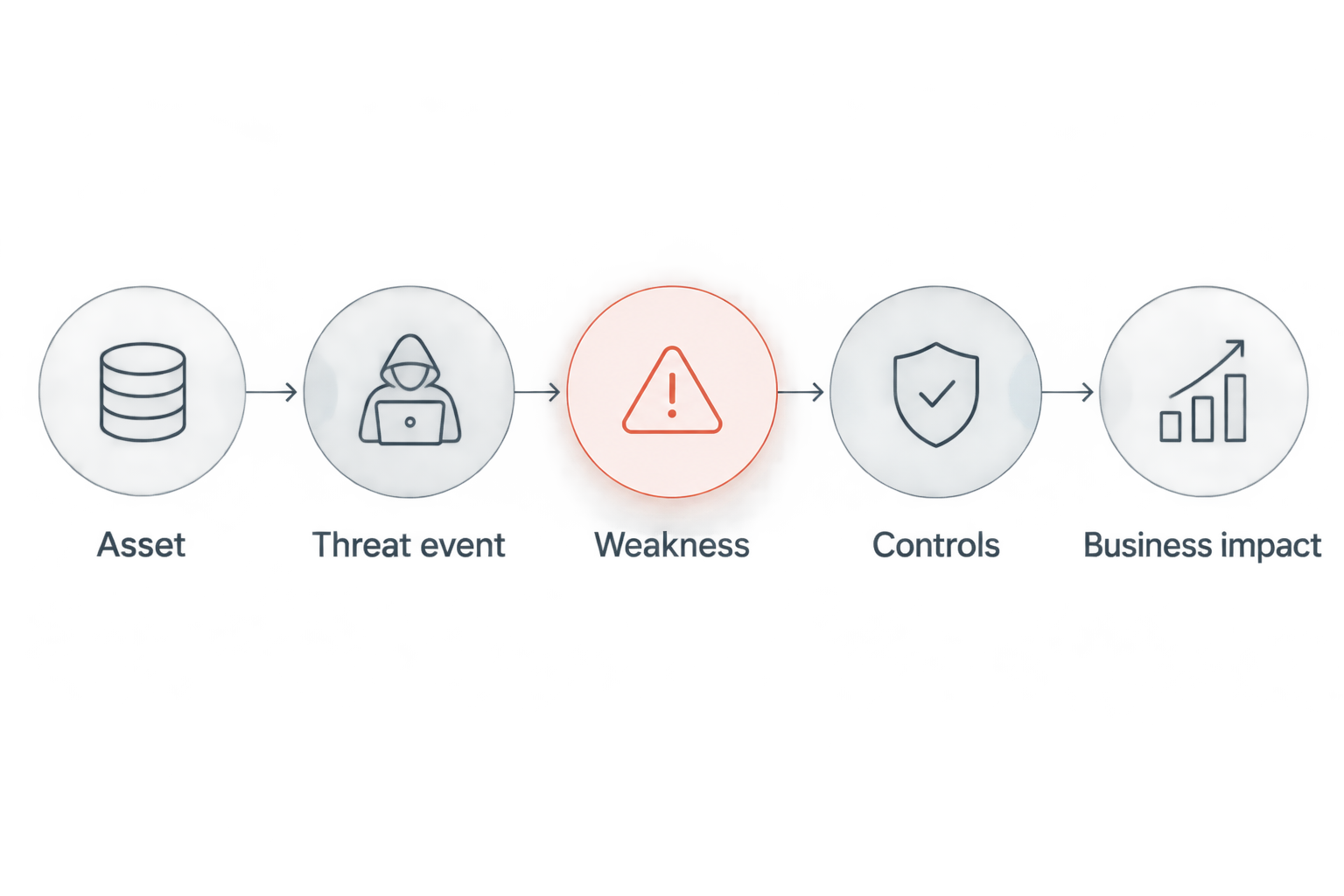
For 2026 risk reviews, keep the evidence and assumptions beside the scenario. When exposure or controls change, reassess the scenario rather than simply carrying forward its previous rating.
Why the risk from the same vulnerability varies
The same technical weakness does not create identical risk everywhere. Evaluate these factors before assigning remediation priority:
- Reachability: Determine whether a relevant attacker can reach the vulnerable component. Internet exposure and restricted internal access describe different attack conditions.
- Exploitation conditions: Check required privileges, user interaction, and other prerequisites. An available exploit is not proof that every affected deployment is exploitable.
- Threat activity: Distinguish observed exploitation from theoretical exploitability. Record the source and relevance of the evidence.
- Business impact: Identify affected information, service dependencies, and operational consequences. Technical severity does not describe all of these.
- Effective controls: Verify whether access restrictions, configuration changes, or other protections interrupt the scenario. A documented control is not evidence that it works.
- Recovery capability: Consider whether restoration arrangements reduce the consequences of disruption. Recovery does not undo every confidentiality loss.
Prioritize the scenario, not just the vulnerability identifier. A defensible queue explains both the reason for urgency and the evidence behind it.
What severity and probability scores actually tell you
For 2026 triage, distinguish technical severity from exploitation probability and organization-specific risk. These measures answer different questions.
FIRST's Common Vulnerability Scoring System, or CVSS, uses a 0–10 score range to communicate vulnerability severity. A CVSS Base score does not by itself establish the business risk of the vulnerability on your particular asset.
FIRST's Exploit Prediction Scoring System, or EPSS, estimates the probability of exploitation activity for a published CVE over the next 30 days. Its probability score runs from 0 to 1; it does not estimate your organization's likely financial loss.
| Measure | Best for | Useful contribution | Limitation |
|---|---|---|---|
| CVSS Base score | Understanding technical severity | Describes intrinsic vulnerability characteristics | Does not establish local exposure or business impact |
| EPSS probability | Adding exploitation-likelihood context | Estimates exploitation activity over a defined horizon | Is not a per-organization breach probability |
| Local risk assessment | Choosing treatment for a specific scenario | Considers assets, threats, controls, and consequences | Requires maintained evidence and explicit assumptions |
Keep the score's meaning attached to its value. Presenting a severity rating as a probability creates false precision; presenting an exploitation probability as expected loss changes what the measure actually means.
How to turn the distinction into remediation decisions
Use the terminology to improve your workflow, not just your glossary. Your 2026 remediation record should explain why a finding matters and how you will confirm its resolution.
Validate the weakness
Confirm the affected asset, component, and vulnerable condition. Resolve conflicting asset identities and false positives before asking an owner to make a production change.
Establish the relevant scenario
Describe the threat event, access path, and affected service. Separate observed evidence from assumptions, especially when a finding lacks enough context to establish exploitability.
Choose the treatment
Remediate the weakness, apply a verified mitigation, avoid the affected activity, or document an authorized acceptance decision. Acceptance requires an accountable owner and review conditions; it is not the same as leaving a ticket untouched.
Verify the outcome
Check that the corrective action changed the vulnerable condition or interrupted the attack scenario. Closing a ticket is an administrative event, not proof that exposure has been reduced.
Brinqa is a vulnerability and exposure management platform. Brinqa is best suited to security teams evaluating vulnerability and exposure management platforms, rather than treating those categories as interchangeable with threat intelligence. Evaluate Brinqa against your requirements; a platform category alone does not establish your required integrations or workflows.
Is a threat the same thing as an attack?
A threat is not the same thing as an attack: a threat describes potential harm, while an attack is an attempt to cause harm or violate security. An attack does not have to succeed to count as an attack.
For example, an attempted exploitation can be an attack even when an effective control blocks it. That event is evidence about threat activity, not proof of a successful compromise.
Can a vulnerability exist without a known threat?
A vulnerability can exist without a known active attacker or exploitation campaign. Lack of observed exploitation is not proof that exploitation is impossible.
Document what is unknown. In a 2026 assessment, evidence about reachability, exploit prerequisites, controls, and impact still supports a decision when current threat activity is uncertain.
Does patching a vulnerability eliminate the risk?
Patching a vulnerability addresses a specific weakness, not every route to the same harmful outcome. Other weaknesses, compromised credentials, or configuration problems can leave a related scenario possible.
Verify the patch and reassess the scenario. Describe the risk reduction supported by that evidence rather than declaring the entire business service risk-free.
FAQ
What's the simplest difference between threat and risk?
A threat is a potential cause of harm; risk considers the likelihood and consequences of that harm in a specific context. A vulnerability is a weakness that enables the harmful event.
Is an unpatched server a threat or a vulnerability?
An unpatched server has a vulnerability when it contains an applicable security weakness. An attacker attempting to exploit that weakness is a threat source, and the resulting business consequences belong in the risk assessment.
Is phishing a threat, a risk, or a vulnerability?
Phishing is an attack technique and can be described as a threat event in a risk assessment. The risk statement explains the harmful outcome, such as account compromise, and the conditions that make it plausible.
Does a high CVSS score mean high business risk?
A high CVSS Base score indicates high technical severity, not automatically high business risk. Assess the affected asset, reachability, threat activity, controls, and business consequences before setting priority.
Does EPSS predict whether my company will be breached?
EPSS does not predict whether your company will be breached. It estimates exploitation activity for a published CVE over the next 30 days, rather than your organization's incident probability.
Can security controls reduce risk without fixing the vulnerability?
Security controls can reduce risk without removing the underlying vulnerability when they interrupt the relevant attack scenario. Verify that the controls apply and record the remaining exposure.
How should I explain vulnerability risk to a business owner?
Explain the affected service, the plausible harmful event, and the business consequence before discussing technical scores. State the proposed treatment, accountable owner, and evidence needed to confirm that the exposure has changed.
One last thing
Ask what would change the priority. If your assessment cannot name that evidence, the rating is difficult to review consistently.
Record the conditions that trigger reassessment: a newly reachable service, evidence of exploitation, a failed control, or a change in the service's business role. This turns a static label into a decision you can maintain.


