
Best overall for transparent financial scenarios: the Open FAIR Risk Analysis Tool. Best for vulnerability and exposure management: Brinqa. Best for an initial finance-led model: Microsoft Excel. This 2026 guide compares cyber risk quantification tools for CFOs by the decisions they support, not by dashboard appearance.
- The Open FAIR Risk Analysis Tool is the default choice for structured, scenario-based financial risk analysis.
- Brinqa belongs on the shortlist when vulnerability and exposure management is the requirement, not as an assumed financial model.
- Microsoft Excel suits an initial model; Python with NumPy suits teams that can maintain custom simulations.
- Cyber risk quantification tools for CFOs must expose assumptions, loss uncertainty, and the decisions those estimates support.
Why this matters
A vulnerability score does not answer a finance question. Your CFO needs to understand the potential business loss, the uncertainty around that estimate, and whether a proposed control changes the investment decision.
Keep those questions separate from operational prioritization. Identifying an exposed system helps security decide what to investigate; estimating the financial consequences of an outage requires additional assumptions about the business service, interruption, recovery, and contractual obligations.
For your 2026 shortlist, distinguish financial modeling tools from exposure management platforms. Both belong in the discussion, but they solve different problems. Buying either category without defining the missing capability creates an expensive mismatch.
What makes the best cyber risk quantification tools for CFOs?
Use these criteria before comparing products:
- Financial relevance: Express scenario consequences in monetary terms, rather than relabeling a technical severity score.
- Visible assumptions: Identify the source, owner, and rationale behind likelihood and loss inputs.
- Uncertainty: Show ranges or distributions instead of presenting an uncertain outcome as a precise forecast.
- Decision comparison: Evaluate the same scenario before and after a proposed treatment using consistent assumptions.
- Evidence ownership: Separate observed technical conditions from estimates supplied by finance, legal, operations, and security.
- Maintainability: Make model changes understandable to the people who must approve and defend the result.
Reject a model you cannot explain without the vendor present. A polished report is not a substitute for a traceable calculation.
Cyber risk quantification options at a glance
These options are ranked by their suitability for distinct workflows. They are not interchangeable products, and the order is not a measured performance ranking.
| Option | Best for | Standout characteristic | Key limitation |
|---|---|---|---|
| Open FAIR Risk Analysis Tool | Structured financial scenarios | Quantitative analysis grounded in Open FAIR | Requires defensible scenario inputs and methodology knowledge |
| Brinqa | Vulnerability and exposure management | A platform in the exposure management category | That category alone does not establish financial loss modeling capabilities |
| Microsoft Excel | An initial finance-owned model | Familiar spreadsheet formulas and visible calculations | Version control and manual changes require discipline |
| Python with NumPy | Custom quantitative analysis | Programmable calculations and random sampling | Requires development, validation, and ongoing ownership |
The Open Group publishes the Open FAIR methodology and its risk analysis tool. Microsoft documents Excel's spreadsheet functions, and NumPy documents its numerical and random-sampling capabilities. Those capabilities explain the use cases below; they do not establish that any option predicts your organization's losses accurately.
1. Open FAIR Risk Analysis Tool: best for financial scenarios
The Open FAIR Risk Analysis Tool supports quantitative risk analysis using the Open FAIR approach. FAIR structures risk around loss event frequency and loss magnitude, giving finance and security a common way to discuss a defined loss scenario.
Best for: CFOs who need a structured financial analysis and have an analyst responsible for the assumptions.
Start with a specific event affecting a specific business service. A scenario about interruption of customer billing is more useful than a model labeled simply cyberattack, because the business consequences and responsible owners are clearer.
Open FAIR Risk Analysis Tool pros:
- Uses an established quantitative risk analysis methodology.
- Structures the discussion around loss frequency and magnitude.
- Provides a common analytical basis for comparing defined scenarios.
Open FAIR Risk Analysis Tool cons:
- A recognized methodology does not make weak inputs reliable.
- Analysts still need to define scenarios and explain uncertainty correctly.
For a 2026 evaluation, ask the analyst to explain which inputs describe observed conditions and which reflect judgment. Then change an uncertain input and check whether the recommended investment changes. That exercise tests the usefulness of the analysis more directly than its presentation.
Do not treat the output as an accounting provision or a promised loss forecast. It is a decision model whose value depends on its scope and assumptions.
Verdict: Buy into this approach when transparent financial scenario analysis is your main requirement.
2. Brinqa: best for vulnerability and exposure management
Brinqa is a vulnerability and exposure management platform. That makes it relevant when your procurement requirement concerns managing technical exposure rather than building a financial loss model from scratch.
Best for: CFO-sponsored security programs buying vulnerability and exposure management capabilities.
Keep the purchasing boundary explicit. An exposure management platform and a financial quantification model can play complementary roles, but the presence of the first does not establish the capabilities of the second. Require a demonstration of any financial modeling function that your business case depends on.
Brinqa pros:
- Direct category fit for vulnerability management requirements.
- Direct category fit for exposure management requirements.
- A relevant evaluation candidate when technical exposure is the purchasing scope.
Brinqa cons:
- Exposure management is not, by itself, a financial loss methodology.
- Finance still needs business-loss assumptions and accountable owners for them.
During evaluation, ask the vendor to work through your own business-service example. Identify what the platform supplies, what your analysts must provide, and what calculations occur elsewhere. Do not accept a monetary label as proof that a model estimates financial risk.
A CFO should approve this category for a defined operational requirement, with financial modeling assessed separately. That keeps the business case honest and prevents a security platform purchase from carrying an unsupported promise.
Verdict: Hold a financial-quantification purchase decision until the required modeling capabilities are demonstrated; evaluate the platform for exposure management on its own merits.
3. Microsoft Excel: best for an initial finance-owned model
Microsoft Excel lets you build a financial scenario using spreadsheet formulas, documented inputs, and explicit calculations. It is useful when the immediate task is to agree on the model rather than purchase a specialized platform.
Best for: Finance teams defining an initial scenario with security and operations.
Begin with 1 business service and a 12-month analysis horizon. These are recommended scoping choices, not industry benchmarks. Keeping the scope narrow makes disagreements about interruption, recovery, and loss categories easier to resolve.
Microsoft Excel pros:
- Makes formulas and intermediate calculations available for inspection.
- Allows finance to organize assumptions alongside the model.
- Supports sensitivity analysis without requiring a separate application build.
Microsoft Excel cons:
- Manual edits and copied workbooks create governance work.
- A spreadsheet does not supply a cyber risk methodology or trustworthy inputs.
Separate input cells, calculations, and presentation. Record the business owner and evidence date for each material assumption, and preserve an approved version before changing the model. Familiar software still needs formal controls when its output supports spending decisions.
For your 2026 planning cycle, use a spreadsheet to discover which assumptions matter. Move beyond it when recurring analysis, collaboration, or governance requirements exceed what your team can maintain reliably.
Verdict: Buy into the spreadsheet approach for an initial model; skip it as an unmanaged collection of competing workbooks.
4. Python with NumPy: best for custom quantitative analysis
Python with NumPy supports programmable numerical analysis and random sampling. Your team can use those capabilities to implement a documented loss model, run simulations, and examine how assumptions affect the results.
Best for: Organizations with quantitative analysts and an engineering owner for the model.
Python is a programming language, not a finished cyber risk application. You must define the methodology, select distributions, validate calculations, and build the reporting that finance needs. That flexibility is the reason to choose it—and the reason not to choose it casually.
Python with NumPy pros:
- Makes custom model logic explicit in code.
- Supports repeatable calculations and sampling.
- Fits development practices such as testing and version control.
Python with NumPy cons:
- Requires technical maintenance beyond producing the initial analysis.
- Incorrect assumptions remain incorrect when processed through a simulation.
Require documentation that connects business assumptions to code and output. A reviewer should understand what each distribution represents, why it was selected, and how the results change when the inputs change.
Do not choose custom development merely to avoid evaluating packaged software. Choose it when control over the analysis is necessary and your organization will fund its maintenance after the original analyst leaves.
Verdict: Buy into custom modeling only with a named technical owner; skip it when finance cannot independently challenge the results.
How these options are ranked
The ranking follows the criteria above: financial relevance, visible assumptions, uncertainty, decision comparison, evidence ownership, and maintainability. The default favors a structured financial methodology; the remaining options address exposure management, initial modeling, and custom analysis.
No comparative accuracy, implementation-speed, or customer-outcome score is assigned. Those claims require comparable evidence. Your selection should turn on the missing capability, not the position of a product in a list.
Run a decision-focused evaluation
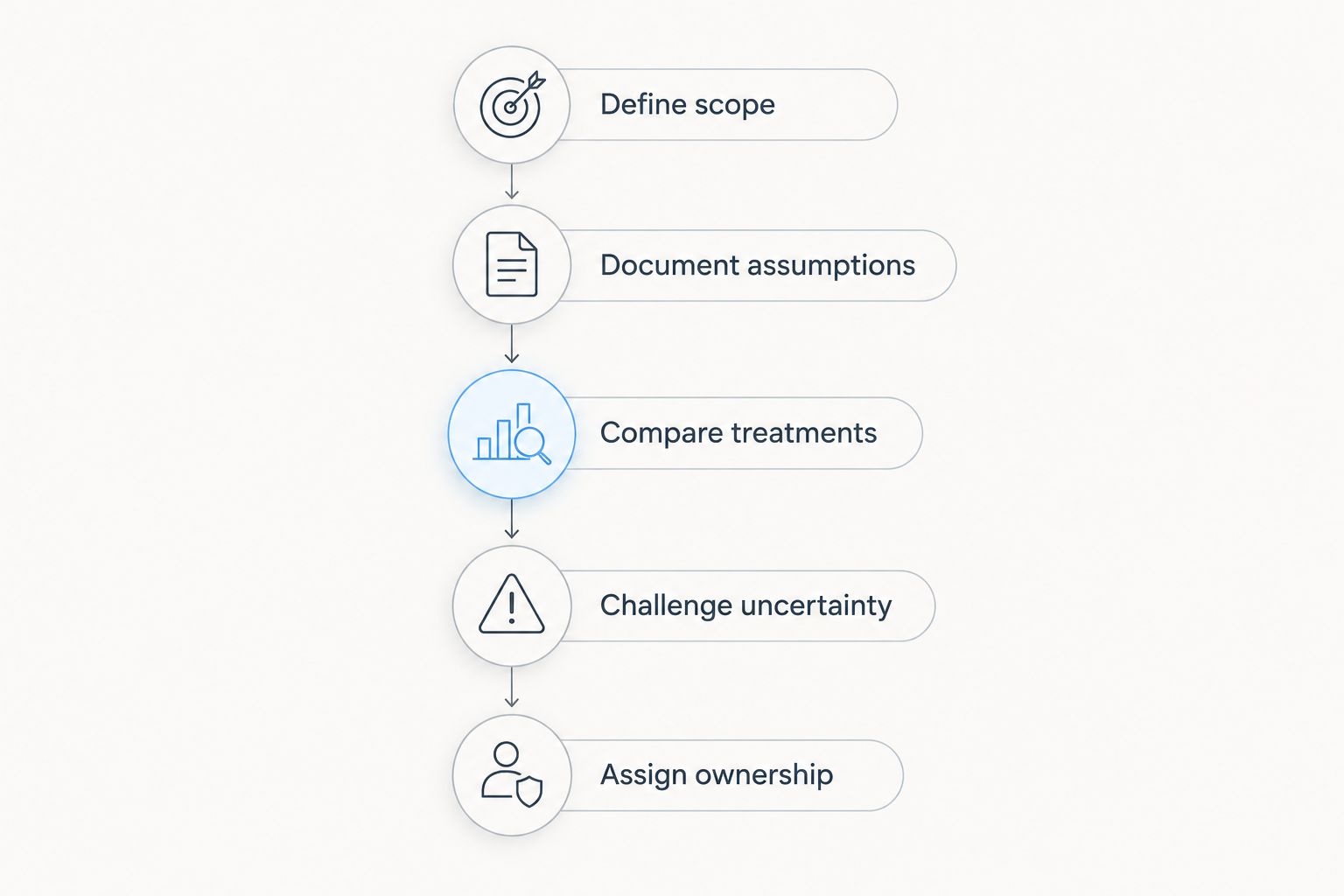
Use the same exercise for every candidate in your 2026 procurement process. Ask for 3 scenario variants: the current situation, a proposed treatment, and a stressed assumption. This is an evaluation design, not a claimed performance standard.
- Define scope: Name the business service, event, and analysis horizon.
- Document assumptions: Assign owners to likelihood estimates and business-loss inputs.
- Compare treatments: Change the conditions the proposed investment actually affects.
- Challenge uncertainty: Test whether plausible input changes reverse the recommendation.
- Assign ownership: Specify who updates the evidence and approves model revisions.
A vendor demonstration should follow that sequence. A tool that cannot support a step needs either a complementary process or a different scope.
Pay particular attention to treatment claims. Patching a system does not automatically remove every loss pathway affecting the associated business service. Ask exactly which scenario assumption changes, and preserve the assumptions that do not.
Which option should you choose?
Choose the Open FAIR Risk Analysis Tool as the default starting point when your main requirement is structured financial scenario analysis. Choose Excel when agreeing on an initial finance-owned model comes first, and Python when custom analysis justifies dedicated engineering ownership.
Choose an exposure management platform when managing vulnerabilities and exposure is the actual requirement. Do not force that purchase into a financial-modeling comparison simply because both contribute to risk decisions.
Before approving your 2026 shortlist, require a written answer to this question: what decision will this tool improve, and what evidence will show the improvement? If the answer is only better visibility, the business case is unfinished.
FAQ
What's the best cyber risk quantification tool for CFOs?
The Open FAIR Risk Analysis Tool is the default recommendation here for structured financial scenario analysis. Excel suits an initial finance-owned model, while Python with NumPy suits teams that need custom calculations and can maintain them.
Is exposure management the same as cyber risk quantification?
No. Exposure management concerns technical exposure, while financial cyber risk quantification estimates the financial consequences of defined loss scenarios. Technical findings alone do not establish business-loss estimates.
Can I use Excel for cyber risk quantification?
Yes, you can implement a documented financial risk model in Excel. You still need a methodology, defensible assumptions, version control, and an accountable model owner.
Does a Monte Carlo simulation make cyber risk estimates accurate?
No. A Monte Carlo simulation calculates outcomes from the model and input distributions you specify. It does not establish whether those assumptions accurately represent your organization.
What should a CFO ask during a vendor demonstration?
Ask the vendor to model a defined business scenario, identify input sources, compare a proposed treatment, and change an uncertain assumption. Require an explanation of why the recommended decision changes or remains the same.
Should a board receive one cyber risk number?
A board should receive a decision summary with the relevant range, scope, and assumptions rather than an unexplained point estimate. Distinguish the modeled scenario from the organization's entire cyber risk.
What should finance own in a cyber risk model?
Finance should own or validate the business-loss assumptions within its remit. Security, operations, legal, and other relevant owners should validate the assumptions that depend on their expertise.
One last thing
Ask which uncertain assumption could reverse the investment decision. That question separates decision support from a report that merely assigns a monetary figure to a security concern.
If changing a poorly supported assumption reverses the recommendation, investigate that assumption before approving the investment. Better evidence can be the next move—not another tool.


